Title here
Summary here
Reverse engineering a Zephyr firmware to find a hidden XOR-obfuscated command in a Ph0wn CTF challenge
I created this challenge for Ph0wn 2026, the CTF dedicated to smart devices and IoT security held every year in Sophia Antipolis. The idea behind “Beeper 1” was to design an approachable firmware reverse engineering challenge: given an R&D firmware (non-release build, not stripped) and a stolen confidential PDF document partially describing the device’s communication protocol, participants had to reverse the firmware to uncover an undocumented hidden command.
This is a pure static reverse engineering challenge. The entire solve can be performed with Ghidra. In this article, I’ll walk through the intended solution step by step.
Participants receive two files:
firmware.elf: an R&D build of the device firmware (ARM Cortex-M33, Zephyr RTOS)doc.pdf: a “stolen” R&D document describing the Pirate Beeper, a tactical communication device built around the STM32H573I-DK board with a CC1101 radio module operating at 433.92 MHzThe PDF documents three known commands (pico_attack, pico_boom, pico_home) along with hardware specs and radio characteristics (OOK modulation, PWM encoding). A “Secret Feature” section is conveniently REDACTED, hinting that there’s more to find in the firmware.
Loading the firmware in Ghidra/IDA, a string enumeration reveals the known commands (pico_attack, pico_boom, pico_home) alongside a suspicious outlier: hide_cmd.
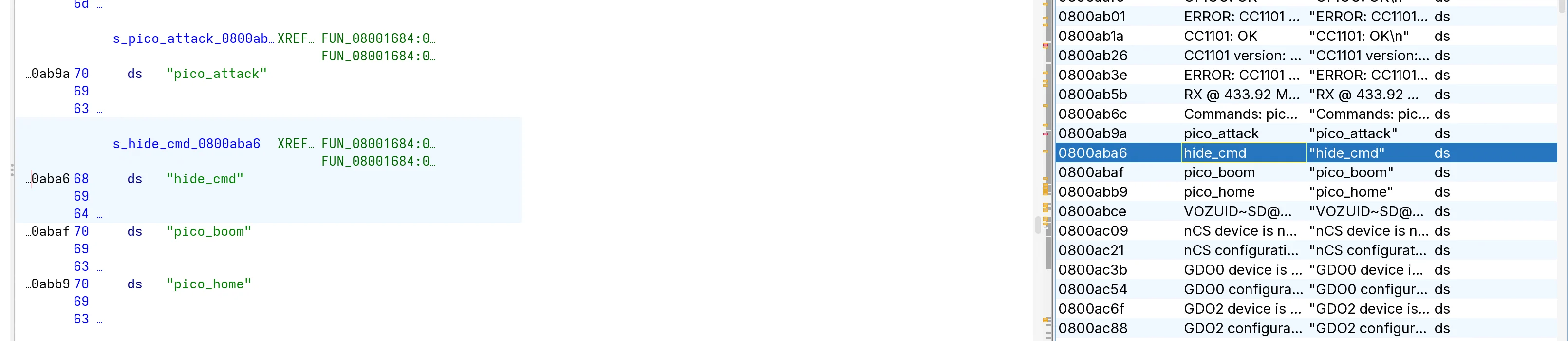
Following the XREF on hide_cmd leads to the command dispatcher. The [RX] Unknown: %s format string, consistent with the PDF’s description of the serial protocol, confirms the function’s role.
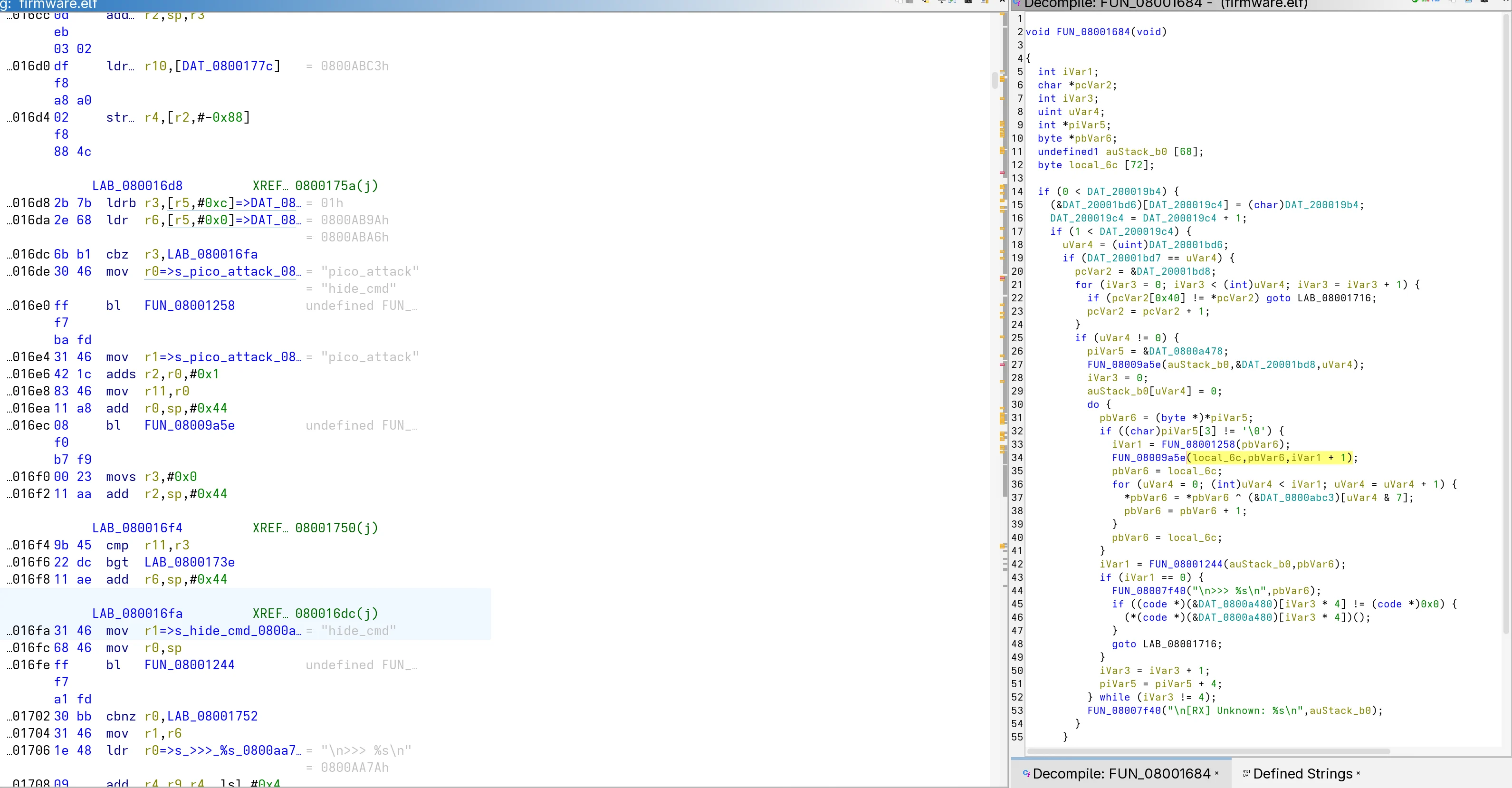
Here is the decompiled code produced by Ghidra:
void FUN_08001684(void)
{
    // ...
    if (uVar4 != 0) {
        piVar5 = &DAT_0800a478;
        FUN_08009a5e(auStack_b0, &DAT_20001bd8, uVar4);
        iVar3 = 0;
        auStack_b0[uVar4] = 0;
        do {
            pbVar6 = (byte *)*piVar5;
            if ((char)piVar5[3] != '\0') {           // obfuscation flag at +12
                iVar1 = FUN_08001258(pbVar6);
                FUN_08009a5e(local_6c, pbVar6, iVar1 + 1);
                pbVar6 = local_6c;
                for (uVar4 = 0; (int)uVar4 < iVar1; uVar4 = uVar4 + 1) {
                    *pbVar6 = *pbVar6 ^ (&DAT_0800abc3)[uVar4 & 7]; // XOR key
                    pbVar6 = pbVar6 + 1;
                }
                pbVar6 = local_6c;
            }
            iVar1 = FUN_08001244(auStack_b0, pbVar6);
            if (iVar1 == 0) {                         // command match
                FUN_08007f40("\n>>> %s\n", pbVar6);
                if ((code *)(&DAT_0800a480)[iVar3 * 4] != (code *)0x0) {
                    (*(code *)(&DAT_0800a480)[iVar3 * 4])();  // call handler
                }
                goto LAB_08001716;
            }
            iVar3 = iVar3 + 1;
            piVar5 = piVar5 + 4;                      // stride: next entry
        } while (iVar3 != 4);                         // 4 commands total
        FUN_08007f40("\n[RX] Unknown: %s\n", auStack_b0);
    }
    // ...
}
Reading the decompiled code reveals a table of 4 entries (loop terminates at iVar3 != 4), each entry being a struct with the following layout:
| Offset | Field | Description |
|---|---|---|
| +0 | char * | Pointer to the command string (*piVar5) |
| +8 | code * | Handler function pointer (&DAT_0800a480 = base 0x0800a478 + 8, called as (*(code *)(&DAT_0800a480)[iVar3 * 4])()) |
| +12 | byte | Obfuscation flag (piVar5[3], since piVar5 is int* → 3×4 = 12) |
In C, this struct can be written as:
struct pico_command {
    const char *cmd;        // +0
    uint32_t    unknown;    // +4  (not accessed in this function)
    void      (*handler)(void); // +8
    uint8_t     xored;      // +12
    uint8_t     pad[3];     // +13 (alignment)
};
The obfuscation flag is the key insight: when it is non-zero, the cmd field (the command name string) is XOR-decoded in-place using the key at DAT_0800abc3 before being compared to the user input. The three known commands have a zero flag and their cmd field is stored as plaintext, hide_cmd is the only entry whose cmd field is XOR-encoded.
Defining this struct in Ghidra makes the data view and decompiled code immediately readable:

By applying the type on DAT_0800a478, the structure becomes directly visible in the firmware data view:
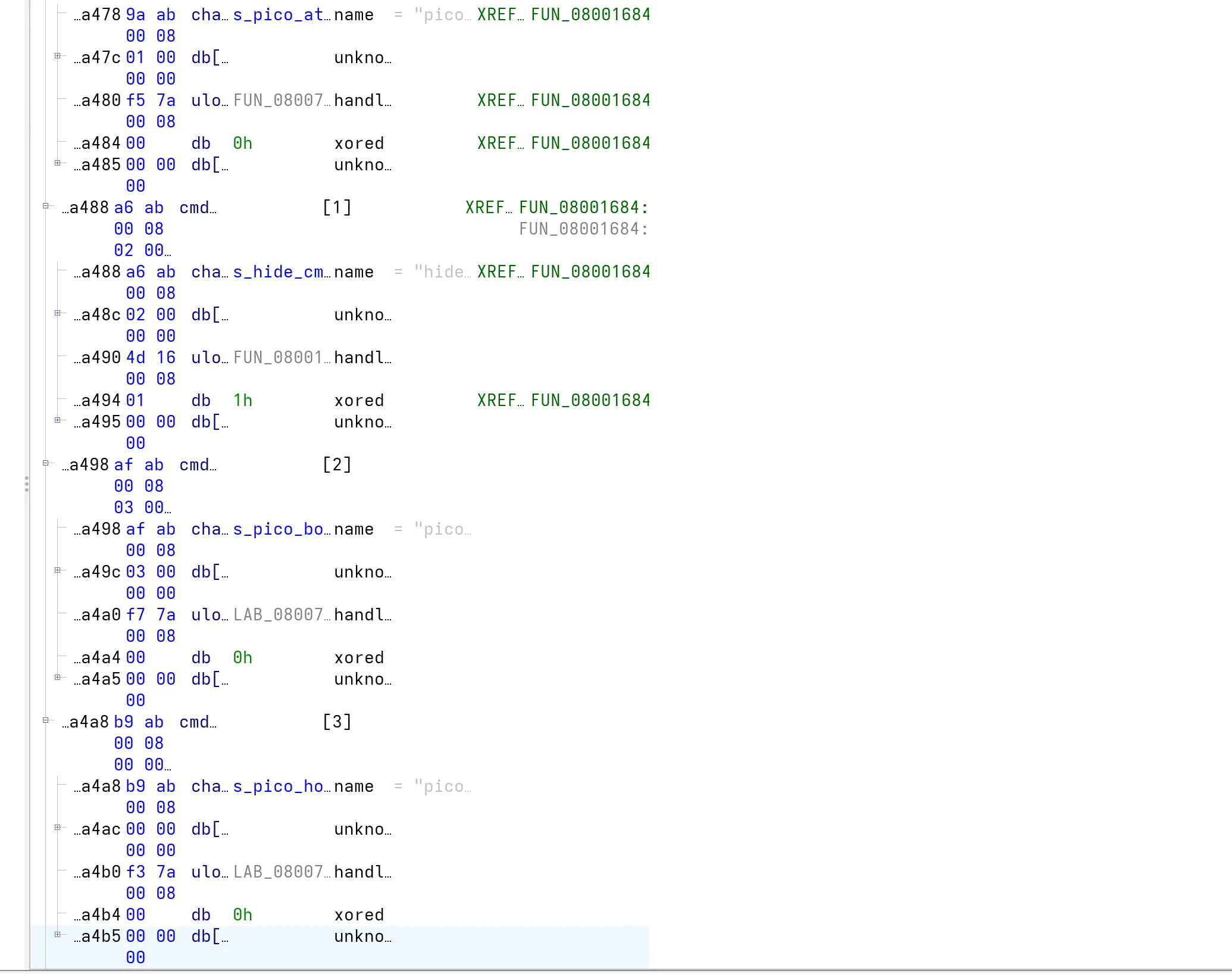
Here we can confirm that only the hide_cmd entry has its xored flag set, meaning only its cmd field is XOR-encoded. We therefore expect a XOR decoding using the key at DAT_0800abc3, which is 8 bytes long.
Navigating to DAT_0800abc3 in the data view reveals the 8 bytes of the XOR key:
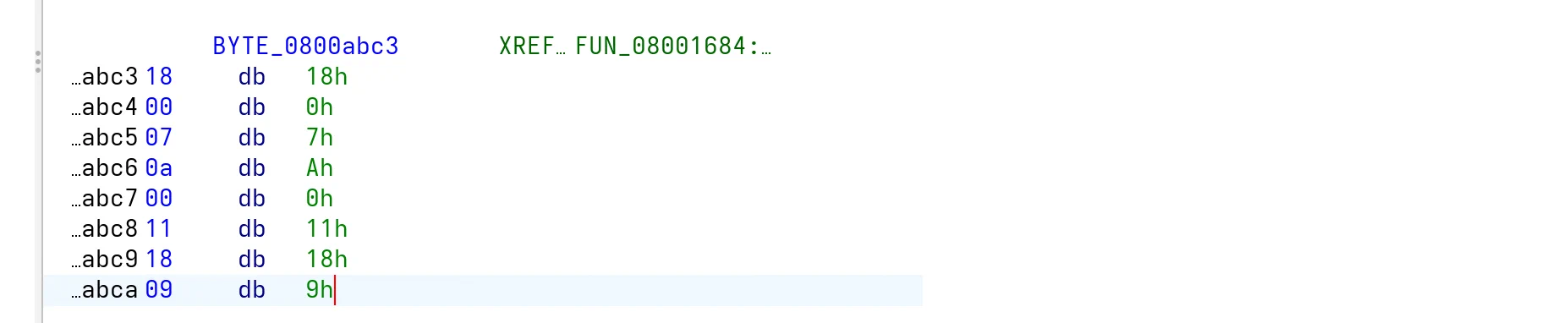
key = [ 0x18, 0x00, 0x07, 0x0A, 0x00, 0x11, 0x18, 0x09 ]Since hide_cmd is the XOR-encoded form of the actual command stored in the binary, the real command string is recovered by XOR-decoding it with the key :
key     = [0x18, 0x00, 0x07, 0x0A, 0x00, 0x11, 0x18, 0x09]
encoded = b"hide_cmd"
decoded = bytes(b ^ key[i % 8] for i, b in enumerate(encoded))
print(decoded)  # the hidden command
The output is pico_rum. This is not a flag in itself, but confirms the existence of an undocumented secret command accepted by the device.
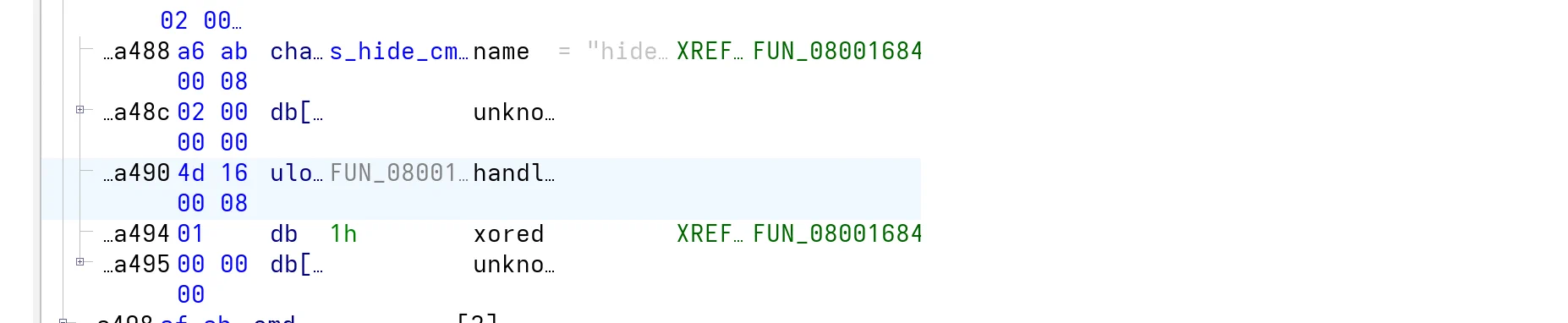
Now that the struct is applied, the pico_rum entry is fully visible in the data view. Its xored flag is set to 0x01 and its handler field points to FUN_0800164c, the function that executes when the command is triggered:
Decompiling FUN_0800164c reveals a straightforward decoding loop: it reads 38 bytes (0x26 iterations) from DAT_0800abcb, XORs each byte with the constant 0x21, and prints the result as a string:
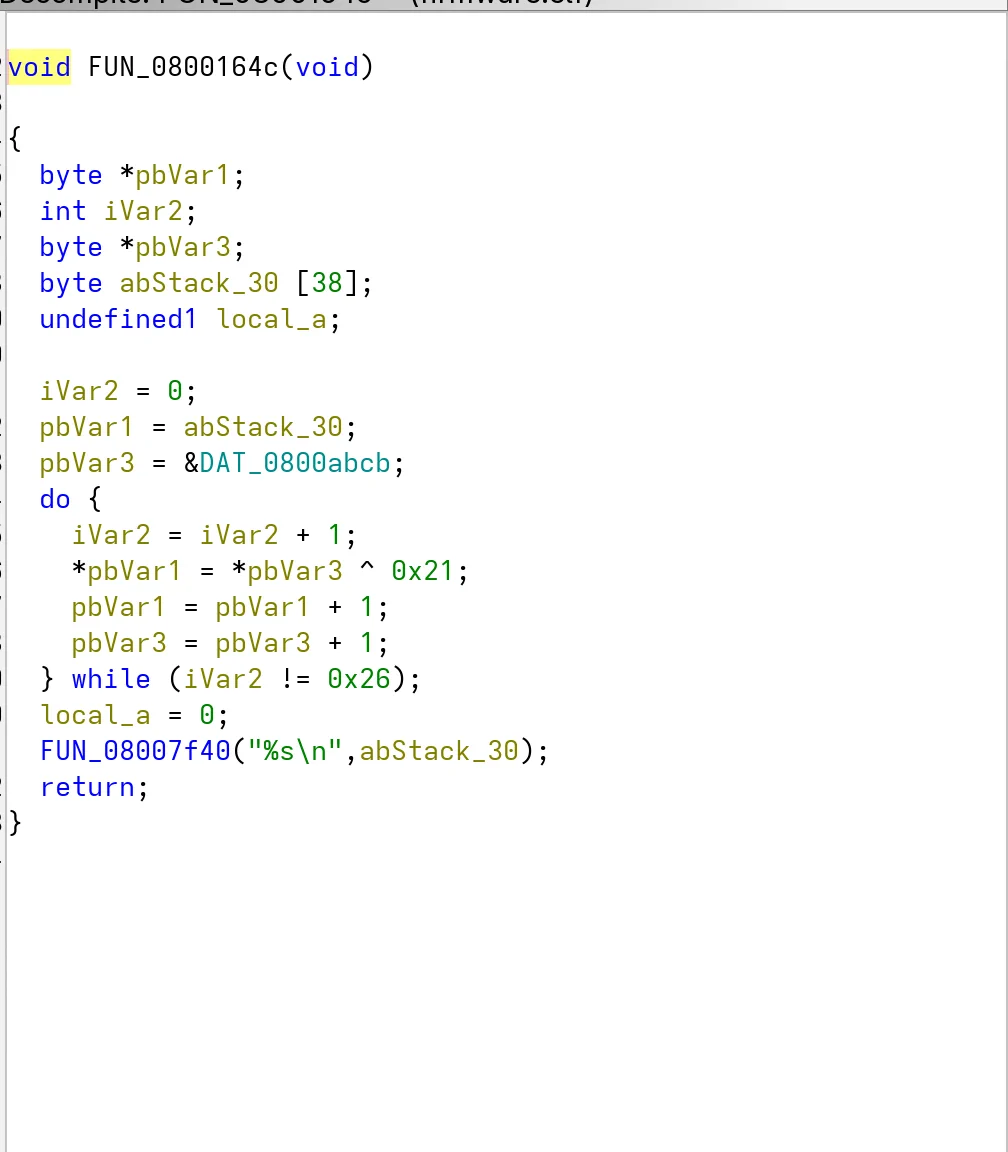
The decoding scheme is simpler than the previous one, a single-byte key with no rotation.
Navigating to DAT_0800abcb exposes the 38 raw encoded bytes:
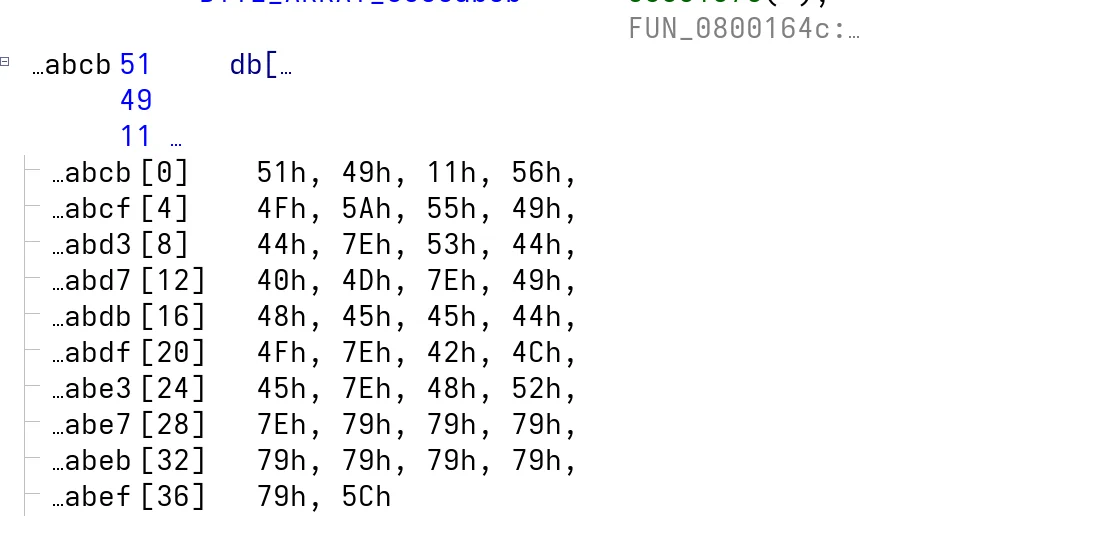
Applying the same logic:
encoded = bytes([
    0x51, 0x49, 0x11, 0x56,
    0x4F, 0x5A, 0x55, 0x49,
    0x44, 0x7E, 0x53, 0x44,
    0x40, 0x4D, 0x7E, 0x49,
    0x48, 0x45, 0x45, 0x44,
    0x4F, 0x7E, 0x42, 0x4D,
    0x45, 0x7E, 0x48, 0x52,
    0x7E, 0x79, 0x79, 0x79,
    0x79, 0x79, 0x79, 0x79,
    0x79, 0x5C
])
decoded = bytes(b ^ 0x21 for b in encoded)
print(decoded.decode())
The decoded string is ph0wn{the_real_hidden_cmd_is_XXXXXXXX}. The 8 X characters are a placeholder whose value was recovered in the previous section: the flag is ph0wn{the_real_hidden_cmd_is_pico_rum}
This challenge was rated easy/medium at Ph0wn. The firmware being a debug build (not stripped) makes the initial string enumeration trivial, and the XOR obfuscation is straightforward once identified. The main difficulty lies in understanding the command dispatcher’s struct layout: recognizing the stride of the loop, mapping the offsets to fields (command string pointer, handler, obfuscation flag), and defining the struct properly in Ghidra to make the data view readable. This kind of struct manipulation is a fundamental skill in firmware reverse engineering, and Beeper 1 was designed as a gentle introduction to it.